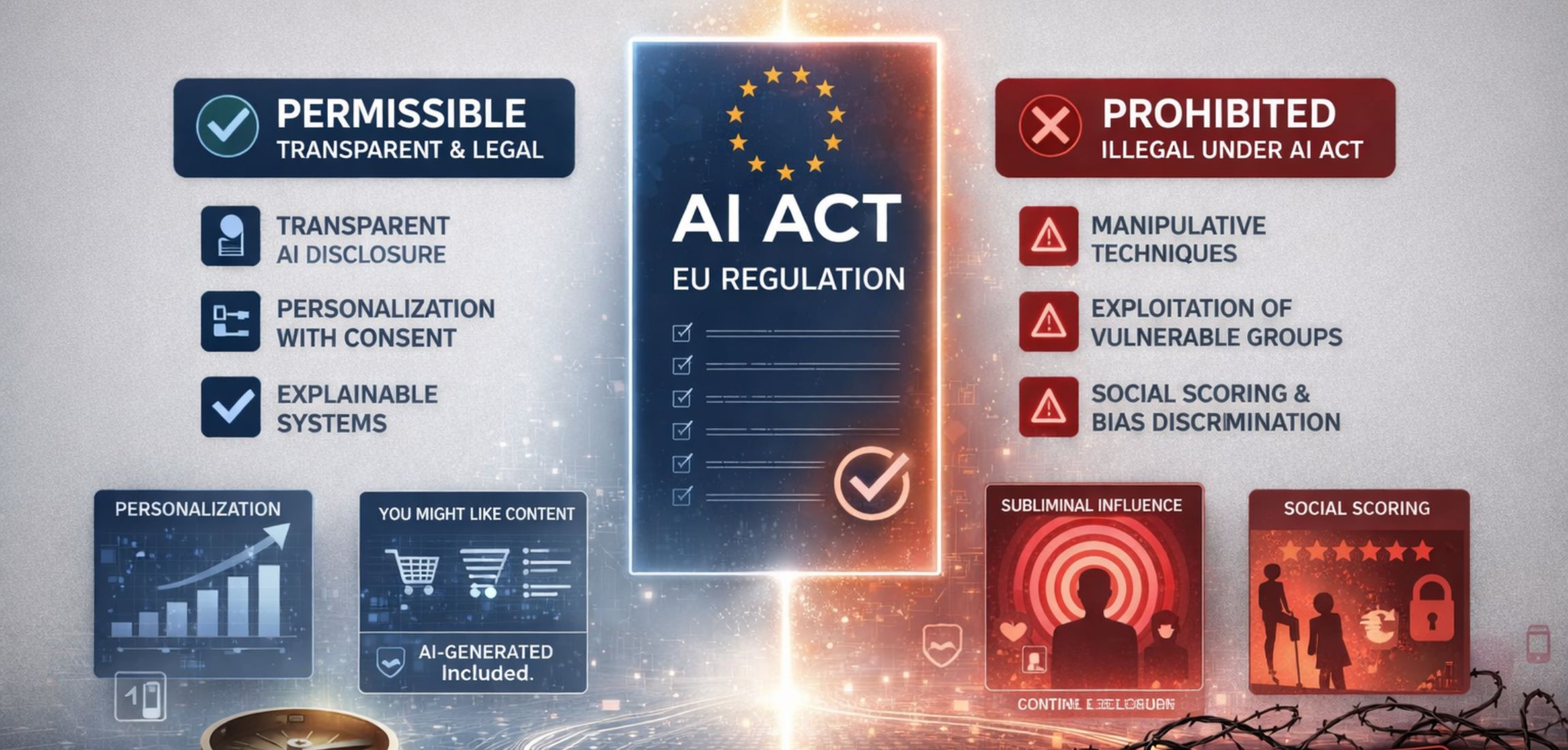
AI Act and Marketing: What Will Become Illegal and What Will Not
The AI Act and marketing strategy are becoming structurally intertwined as artificial intelligence moves from experimentation to regulated deployment within the European Union. With…


Digital reputation is a long-term organisational asset shaped by accumulated behaviour, stakeholder experience, and public evaluation, rather than simply by the content a brand publishes. As digital communication becomes increasingly automated, organisations can produce more messages, maintain greater visibility, and influence how they are presented across multiple platforms. Yet none of these capabilities guarantees a stronger reputation.
The distinction is important because digital reputation is frequently approached as a communication problem. Organisations invest in content production, social media management, search visibility, and brand monitoring, expecting these activities to establish credibility over time.
Communication certainly influences reputation. It determines which information becomes accessible and how organisational decisions are explained. But reputation develops through a broader process involving what organisations do, how stakeholders experience those actions, and whether public claims remain consistent with observable reality.
A reputation can be communicated, but it cannot be manufactured independently of the conditions that sustain it.
Digital reputation refers to the collective evaluations and expectations associated with an organisation across digitally mediated environments. These evaluations emerge from direct experience, public information, independent commentary, professional relationships, and previous organisational conduct.
Visibility contributes to this process by making information accessible. It does not determine how that information will be interpreted.
A company may achieve strong search rankings, publish extensively, and maintain an active social media presence without being regarded as particularly reliable. Another organisation may communicate less frequently while maintaining substantial credibility among customers, partners, or professional communities.
This distinction reflects the broader problem of visibility without credibility. Exposure increases the opportunity for evaluation, but the outcome depends on the evidence audiences encounter.
Reputation therefore cannot be reduced to the volume or reach of communication. It concerns the conclusions stakeholders draw from the information and experiences available to them.
Content strategies operate through relatively controllable processes. Organisations decide what to publish, when to publish it, which channels to use, and how communication should reflect their intended positioning.
Reputation operates differently.
Although organisations can influence the information available about them, they cannot fully control how stakeholders interpret it. Customers discuss experiences independently. Employees form opinions through internal interactions. Partners evaluate reliability through commercial relationships. Public institutions and professional communities assess conduct according to their own expectations.
These evaluations may reinforce official communication, but they can also contradict it.
An organisation that repeatedly communicates its commitment to customer service while delivering inconsistent support creates a discrepancy that additional content cannot resolve. More communication may even make the contradiction more visible.
This is why reputation management should not be understood primarily as message management.
Its central concern is the relationship between organisational conduct and stakeholder evaluation. Communication can explain that relationship, but it cannot substitute for it.
Unlike individual marketing campaigns, reputation has a cumulative character.
A positive customer interaction may strengthen confidence. Reliable delivery over several years can establish expectations of competence. Transparent responses to problems may demonstrate accountability. Conversely, repeated inconsistencies can gradually weaken the credibility previously established.
Not every experience carries equal weight. Serious failures may damage reputation disproportionately, particularly when they challenge assumptions about integrity or competence.
This makes reputation development neither linear nor entirely predictable.
The same organisational action may also be interpreted differently by different stakeholders. A decision viewed positively by investors may raise concerns among employees or customers. Reputation is therefore not necessarily a single, uniform assessment shared across all audiences.
Nevertheless, accumulated experience creates a form of organisational memory.
Stakeholders develop expectations about how an organisation is likely to behave. Those expectations influence future decisions, often before a new transaction or interaction occurs.
Reputation has economic significance because it can influence decisions under uncertainty.
Consumers cannot always evaluate product quality before purchasing. Business partners may lack complete information about an organisation’s reliability. Prospective employees cannot fully anticipate their experience within a company.
In such situations, reputation functions as an informational signal.
A credible organisation may face lower perceived risk, stronger willingness to engage, and greater confidence among relevant stakeholders. These effects can support commercial relationships, recruitment, negotiations, and long-term market positioning.
However, reputation should not be confused with an asset that can always be assigned a precise financial value. Its contribution is context-dependent and difficult to isolate from other organisational capabilities.
Its strategic importance lies partly in the fact that it develops through accumulated conduct and cannot easily be reproduced by competitors.
Advertising exposure can be purchased. Content formats can be imitated. A history of reliable behaviour is more difficult to replicate.
Digital platforms have become important intermediaries in reputation formation.
Search engines organise information about organisations. Review platforms aggregate customer evaluations. Social networks distribute public commentary. Marketplaces display ratings, complaints, and seller performance indicators.
These systems make reputation more visible, but they also influence how it is represented.
A numerical rating compresses diverse experiences into a simplified indicator. Search results may prioritise recent or highly engaged content. Social discussions can amplify exceptional experiences that are not necessarily representative of typical interactions.
Platform-mediated reputation is therefore a partial representation of a more complex organisational reality.
This creates two challenges.
First, organisations become dependent on external systems to communicate signals about their credibility. Second, stakeholders may interpret simplified indicators without understanding the conditions under which they were produced.
A strong reputation strategy must recognise these limitations without dismissing the value of independent evaluation.
Artificial intelligence introduces additional complexity into the relationship between communication and reputation.
Generative systems can produce large volumes of professional content, replicate communication styles, and maintain a consistent public presence across channels. They can also accelerate the circulation of inaccurate information or create convincing representations that are difficult to verify.
For organisations, this increases the importance of distinguishing between controlled communication and independently substantiated credibility.
AI-generated material may accurately represent genuine organisational expertise. It may also create the appearance of expertise where little exists.
The underlying problem is not the technology itself, but the distance that can emerge between representation and reality.
As automated communication becomes more common, audiences may place greater importance on signals that are harder to manufacture: consistent performance, identifiable responsibility, independent validation, and a credible history of decisions.
The capacity to publish convincingly becomes less distinctive when almost every organisation can do so.
Organisations sometimes approach reputation protection as an attempt to eliminate criticism.
This is neither realistic nor necessarily desirable.
Criticism may reflect genuine operational problems, conflicting stakeholder interests, or legitimate disagreements about organisational decisions. Attempting to suppress every negative assessment can create additional reputational risk, particularly when audiences perceive a lack of transparency.
Credibility does not require an absence of mistakes.
It requires a sufficiently reliable relationship between organisational claims, actual behaviour, and responses when expectations are not met.
A company that acknowledges a service failure and addresses its causes may preserve more confidence than one that maintains polished communication while avoiding responsibility.
This does not mean every criticism must be accepted as accurate. Organisations can reasonably challenge misleading information or explain contested decisions.
The relevant distinction is between defending a reputation through evidence and attempting to control perception independently of evidence.
Content performance is usually evaluated through measurable indicators: impressions, engagement, website visits, search visibility, and conversions.
These metrics can reveal whether communication reaches and interests an audience. They provide limited information about the durability of stakeholder confidence.
A highly shared article may improve recognition without changing professional credibility. A controversial campaign may generate extensive engagement while weakening the associations an organisation wants to maintain.
Conversely, communication addressing a narrow professional audience may produce modest traffic while supporting valuable long-term relationships.
The measurement problem arises when organisations treat immediate attention as a substitute for reputational outcomes.
Reputation requires a longer observation period and a broader evidence base. Customer retention, complaint patterns, professional recommendations, stakeholder confidence, and consistency of organisational conduct may provide useful signals, although none is sufficient in isolation.
The purpose is not to reduce reputation to another dashboard. It is to avoid confusing communication performance with organisational trustworthiness.
A significant consequence of treating reputation as an asset is that responsibility cannot remain exclusively within marketing or corporate communication.
Customer service influences reputation through responsiveness and reliability. Human resources affects employee experience. Product and operational teams shape expectations through quality and delivery. Leadership decisions influence perceptions of competence, integrity, and accountability.
Marketing communicates within this broader organisational context.
When departments operate according to conflicting priorities, reputation can become fragmented. Public messages may emphasise long-term relationships while operational incentives reward immediate transactions.
A coherent reputation therefore depends on organisational alignment rather than communication consistency alone.
This also explains why reputation cannot be delegated entirely to an agency, technology provider, or automated communication system.
External specialists can support its representation and monitoring. The underlying conditions remain organisational responsibilities.
The strategic value of digital reputation is often most visible when circumstances become uncertain.
Markets change, products evolve, and communication channels lose relevance. Organisations with established credibility may retain stakeholder confidence through such transitions because their previous conduct provides a basis for interpreting new decisions.
That confidence is not unconditional. It must continue to be supported by behaviour.
Nevertheless, reputation creates continuity between an organisation’s past actions and its future opportunities.
This is what distinguishes it from a content strategy.
Content can explain expertise, document decisions, and make organisational values visible. Reputation emerges when stakeholders find sufficient evidence to regard those representations as credible.
The distinction becomes more consequential as artificial intelligence makes communication increasingly abundant.
In an environment where almost any organisation can produce polished content at scale, the ability to communicate convincingly will become less exceptional. The harder achievement will remain developing a record of conduct that gives audiences a reason to believe what is communicated.
Digital reputation is not the accumulated result of everything an organisation publishes. It is the accumulated judgment of what the organisation has demonstrated itself to be.
Article by Dario Sipos.
Dario Sipos, Ph.D., is a Digital Marketing Strategist, Branding Expert, Keynote Public Speaker, Business Columnist, Author of the highly acclaimed books Digital Personal Branding and Digital Retail Marketing.
Readers who wish to explore the underlying research, citations, and peer-reviewed publications can find them via his Google Scholar Profile.
His verified academic identifier is available through ORCID.
The AI Act and marketing strategy are becoming structurally intertwined as artificial intelligence moves from experimentation to regulated deployment within the European Union. With…

Marketing after automation requires redefining what remains human in strategic communication. As artificial intelligence systems assume greater responsibility for targeting, optimisation…

More data in personalization strategy does not automatically produce better personalization outcomes. In contemporary digital marketing, the accumulation of behavioural…