
Why Retailers Are Losing Control of Customer Relationships
Retailers are losing control of customer relationships as platform infrastructures, data asymmetries, and AI-mediated interfaces redefine how interaction, visibility, and loyalty are…


Retail media, artificial intelligence, and consumer attention are becoming structurally intertwined as platform-based commerce redefines how visibility is allocated and monetized. Over the past decade, digital marketing has been shaped by search engines and social platforms that mediate access to audiences. Increasingly, however, retail platforms are assuming a comparable role, transforming from transactional environments into media ecosystems.
This shift is not merely an extension of e-commerce. It represents a reconfiguration of how attention is captured, prioritised, and sold. Retail media networks—operated by large commerce platforms—combine first-party data, closed-loop attribution, and AI-driven optimisation to create highly controlled environments where visibility is directly linked to commercial intent.
For marketing strategy, the implications are structural. The competition for attention is no longer confined to external channels directing users toward purchase. It is embedded within the point of purchase itself.
Retail media networks have evolved rapidly from promotional tools into full-scale advertising ecosystems. Platforms such as large online marketplaces and omnichannel retailers now offer sponsored placements, search advertising, display formats, and recommendation systems within their own environments.
What distinguishes retail media from traditional digital advertising is the proximity to transaction. While search and social platforms infer intent through behaviour, retail platforms observe it directly. Every search query, product view, and purchase contributes to a dataset that reflects immediate commercial interest.
This proximity transforms advertising logic. Instead of targeting potential interest, brands compete for visibility within confirmed demand environments. The platform becomes both marketplace and media owner, controlling the interface through which choices are presented.
AI systems play a central role in this infrastructure. They determine ranking, allocate sponsored placements, optimise bids, and personalise recommendations. Attention is no longer distributed through static positioning; it is dynamically recalibrated based on behavioural signals and commercial incentives.
In retail media environments, artificial intelligence functions as an allocation mechanism. It determines which products appear, in what order, and under which conditions. Sponsored placements are integrated into organic results, often indistinguishable in format, though labelled.
This integration blurs the boundary between relevance and promotion. Products may be surfaced because they align with user intent, because they generate higher margin for the platform, or because advertisers are willing to pay for visibility. In practice, these factors interact.
From a strategic perspective, this introduces a new form of competition. Brands are no longer competing solely on product quality, pricing, or brand recognition. They are competing within algorithmic systems that mediate attention based on both behavioural data and commercial input.
The optimisation objective shifts. Visibility becomes contingent on participation in the platform’s advertising ecosystem. Organic reach exists, but it is increasingly shaped by the same data signals that inform paid placement.
Retail media accelerates the convergence between media and commerce. Historically, these domains were sequential: marketing generated awareness, which led to consideration, which culminated in purchase. In retail media environments, these stages collapse.
The point of discovery, evaluation, and transaction becomes a single interface. Sponsored listings appear alongside organic results; recommendations are personalised in real time; purchase decisions occur within the same environment where influence is exerted.
This convergence alters the nature of attention. It becomes transactional rather than exploratory. Users enter the environment with intent, and the system shapes how that intent is resolved.
For marketers, this reduces the distance between influence and outcome. It also increases dependence on platform-controlled mechanisms. The ability to shape attention externally diminishes relative to the need to compete within the platform itself.
A defining feature of retail media is its reliance on first-party data. As third-party tracking becomes restricted through regulatory and platform changes, data collected directly within retail environments gains strategic value.
Retailers possess detailed, transaction-level data that external platforms cannot replicate. This includes purchase history, frequency, basket composition, and category preferences. AI systems use this data to refine targeting and optimise placements.
The consequence is a reconfiguration of power. Brands that once relied on external channels for audience access now depend on retail platforms that control both data and distribution. The retailer is no longer a neutral intermediary; it becomes an active participant in the allocation of attention.
This dynamic introduces asymmetry. Platforms can prioritise their own products, adjust ranking logic, and monetise visibility through advertising formats. Even under regulatory scrutiny, the structural advantage of first-party data remains significant. This shift also contributes to a broader pattern in which retailers are losing control of customer relationships as interaction becomes increasingly mediated by platform infrastructures.
Retail media formalises the monetization of visibility at the point of purchase. Shelf space, once a physical constraint negotiated through trade relationships, becomes digital and algorithmically managed.
Sponsored placements function as paid shelf positioning. The difference is scale and flexibility. Digital shelf space can be expanded, reconfigured, and personalised for each user. AI systems determine how many sponsored placements appear, where they are positioned, and how they interact with organic results.
This creates a layered visibility structure. Products compete across multiple dimensions: organic ranking, paid placement, recommendation inclusion, and promotional eligibility. Attention is fragmented across these layers.
For brands, the implication is clear. Visibility is no longer secured solely through distribution agreements or brand strength. It requires continuous participation in platform-driven bidding and optimisation systems.
As retail media becomes central to digital strategy, dependence on platform ecosystems increases. Brands may allocate significant portions of their marketing budgets to retail media networks, given their proximity to conversion and measurable return.
However, this dependence carries strategic risk. Platform rules, pricing structures, and algorithmic priorities can change. Margins may be compressed as competition for placement intensifies. Data access remains controlled by the platform, limiting external analysis.
This environment requires careful calibration. While retail media offers efficiency and measurable outcomes, over-reliance may reduce strategic flexibility. Brands may find it difficult to differentiate if visibility is mediated primarily through platform-controlled systems.
The challenge is to engage effectively without ceding strategic autonomy.
In retail media environments, attention is not an open field; it is a controlled resource. Platforms determine how much attention is available, how it is distributed, and under what conditions it can be accessed.
AI systems optimise this distribution continuously. They balance user experience, platform revenue, and advertiser demand. The outcome is an environment where attention is scarce, priced, and dynamically allocated.
This contrasts with earlier phases of digital marketing, where attention could be captured through content, search optimisation, or social engagement with relatively lower barriers. In retail media, access to attention is more tightly regulated by platform logic.
Strategically, this shifts the focus from capturing attention broadly to competing for it within defined systems.
Retail media, powered by artificial intelligence, redefines the competitive landscape of digital marketing. It embeds advertising within commerce, integrates data and distribution, and transforms attention into a managed asset.
The new battle for consumer attention is not fought solely across external channels. It takes place within algorithmic marketplaces where visibility is allocated through a combination of behavioural data and commercial input.
For organisations, the challenge is to navigate this environment without reducing strategy to platform optimisation alone. Participation in retail media ecosystems is increasingly necessary, but it must be balanced with efforts to maintain brand differentiation, data independence, and strategic flexibility.
As digital markets continue to evolve, attention will remain central. What changes is how it is structured, who controls it, and under what conditions it can be accessed.
Article by Dario Sipos.
Dario Sipos, Ph.D., is a Digital Marketing Strategist, Branding Expert, Keynote Public Speaker, Business Columnist, Author of the highly acclaimed books Digital Personal Branding and Digital Retail Marketing.
Readers who wish to explore the underlying research, citations, and peer-reviewed publications can find them via his Google Scholar Profile.
His verified academic identifier is available through ORCID.
Retailers are losing control of customer relationships as platform infrastructures, data asymmetries, and AI-mediated interfaces redefine how interaction, visibility, and loyalty are…

The AI Act and marketing strategy are becoming structurally intertwined as artificial intelligence moves from experimentation to regulated deployment within the European Union. With…
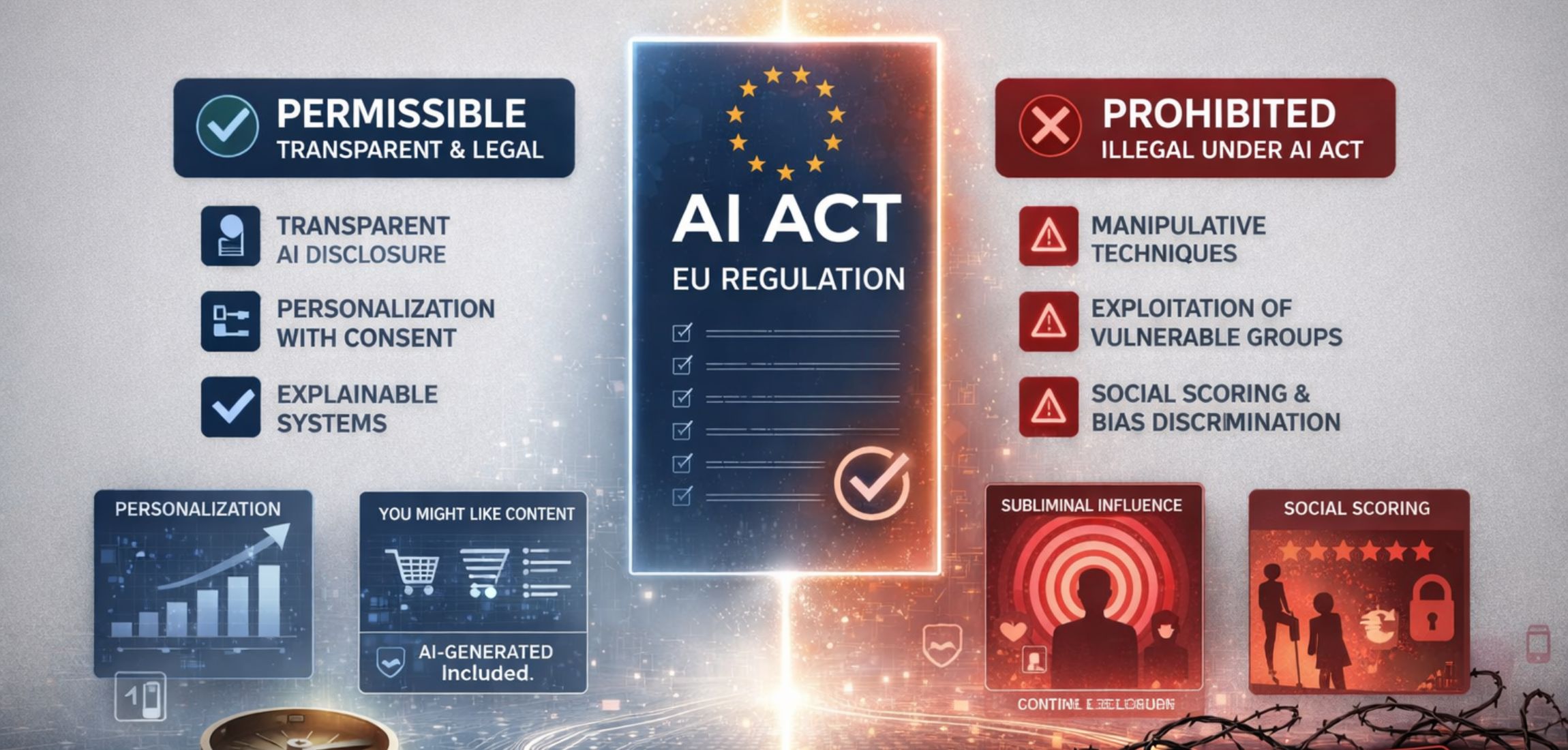
The AI Act and marketing strategy are becoming structurally intertwined as artificial intelligence moves from experimentation to regulated deployment within the European Union. With…