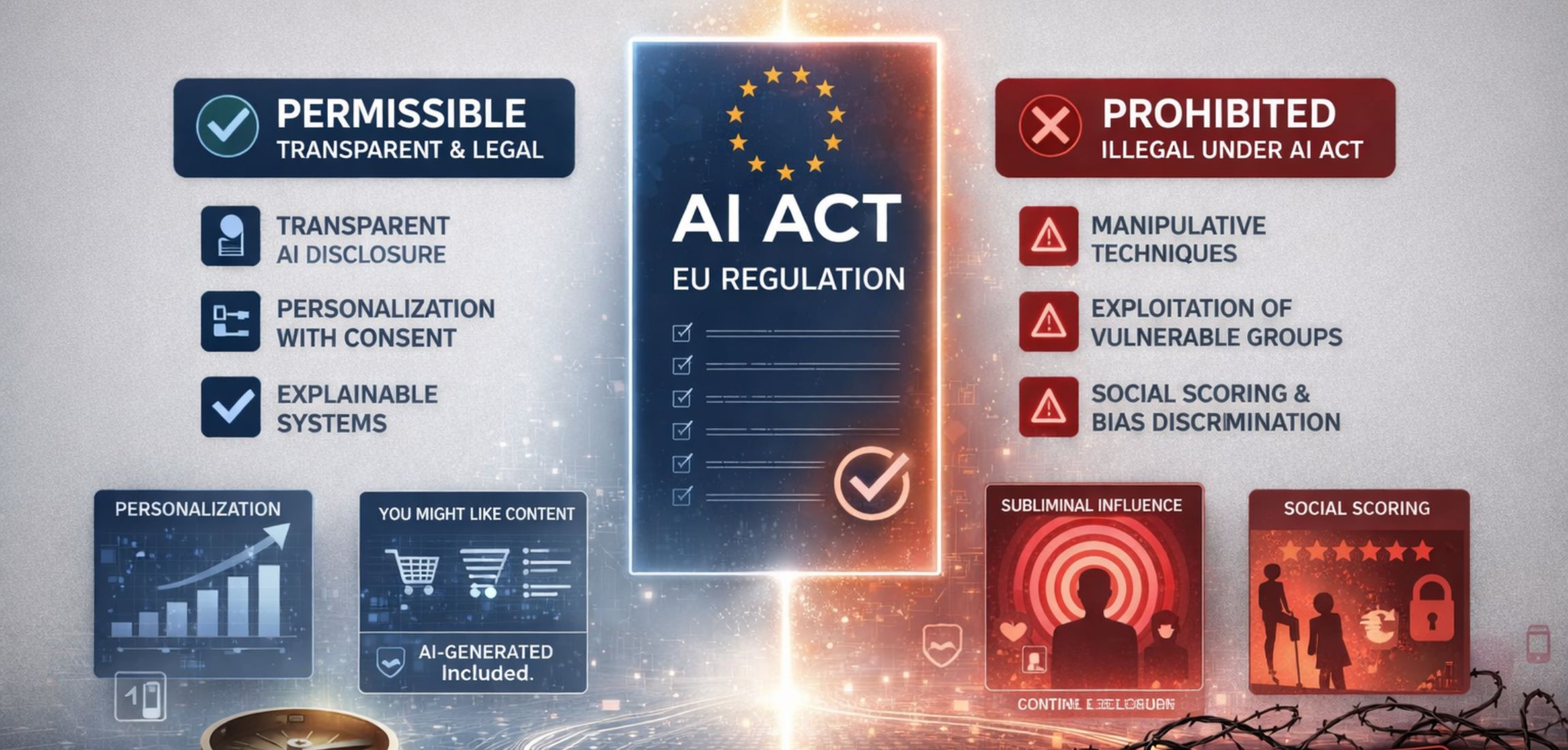
AI Act and Marketing: What Will Become Illegal and What Will Not
The AI Act and marketing strategy are becoming structurally intertwined as artificial intelligence moves from experimentation to regulated deployment within the European Union. With…


Visibility without credibility is a growing strategic risk in digital marketing because attention can be generated faster than the trust required to sustain it. Digital platforms have made it possible for organisations, brands, and individuals to reach audiences at a scale that would have been difficult to achieve through traditional communication channels. Advertising, search engines, social networks, and automated content distribution can generate substantial exposure within relatively short periods.
Yet visibility and credibility are not equivalent. Being seen does not mean being trusted. Recognition does not necessarily imply expertise, and frequent communication does not establish reliability.
This distinction becomes increasingly important as artificial intelligence reduces the cost of producing and distributing content. Organisations can maintain a continuous digital presence without a corresponding increase in knowledge, competence, or accountability.
The strategic problem is not excessive visibility itself. It is the possibility that communication expands beyond the credibility an organisation can reasonably support.
Digital marketing has developed sophisticated methods for measuring visibility. Impressions, reach, search rankings, website traffic, and social engagement provide information about how frequently a brand appears within digital environments.
These indicators are useful, but they describe exposure rather than evaluation.
A consumer may recognise a brand without understanding what it offers. A professional may encounter an organisation repeatedly without considering it authoritative. A company may dominate search results while remaining relatively unknown in the professional communities whose judgments influence purchasing decisions.
Visibility establishes the possibility of recognition. Credibility requires an additional process.
Audiences must evaluate whether the source is competent, whether its claims are reliable, and whether its behaviour supports the expectations created through communication.
These assessments are influenced by experience, independent evidence, reputation, consistency, and perceived expertise. They cannot be inferred directly from audience size.
The distinction matters because organisations frequently treat increased visibility as evidence of stronger market positioning. In reality, visibility may expand while credibility remains unchanged.
Digital platforms are designed to distribute and organise attention. Their ranking and recommendation systems rely on measurable signals such as engagement, relevance, popularity, and predicted user behaviour.
Credibility is more difficult to evaluate.
A platform can observe whether users click on an article, watch a video, or share a post. It cannot reliably determine from those actions alone whether the information is accurate, whether the author possesses genuine expertise, or whether the communication reflects responsible organisational conduct.
Consequently, content that attracts attention may receive additional distribution regardless of its long-term reputational value.
This creates an asymmetry between what platforms can measure and what organisations ultimately need.
Visibility can be optimised through relatively immediate feedback. Credibility develops through slower processes involving verification, experience, and repeated evaluation.
When organisations adapt their communication primarily to platform incentives, they risk allowing distribution mechanisms to shape their understanding of success.
A highly visible message may perform well within the platform while contributing little to the credibility of its source.
Generative AI intensifies this problem by making competent communication easier to produce.
Articles can be drafted quickly. Professional-looking visual materials can be generated at scale. Complex topics can be summarised, reformulated, and distributed across multiple channels with limited additional effort.
These capabilities can improve communication efficiency. They also reduce the significance of production quality as an indicator of expertise.
A polished article no longer necessarily reflects extensive research. A confident explanation does not establish that its author understands the subject. Professional presentation becomes increasingly accessible, including to organisations whose underlying competence may be limited.
This does not mean AI-assisted communication is inherently less credible. The decisive issue is whether the claims, reasoning, and judgments remain connected to genuine expertise and verifiable evidence.
The challenge resembles the broader transformation discussed in When Everyone Uses AI, What Still Makes a Brand Human? As technical production becomes more widely available, differentiation increasingly depends on the judgment and accountability behind communication rather than its surface quality.
Content abundance therefore changes the relationship between visibility and authority. Producing more material may increase opportunities for exposure without strengthening the reasons audiences should trust its source.
Credibility is not simply a perception that can be created through messaging. It is an assessment that audiences make using available evidence.
In professional and organisational contexts, that evidence may include demonstrated competence, previous performance, recognised qualifications, transparent decision-making, independent evaluations, and consistency between public claims and observable conduct.
Different audiences will weigh these signals differently.
For a consumer purchasing an inexpensive product, credibility may depend largely on previous experience, reviews, and the reliability of the transaction. For an executive selecting a strategic adviser, professional competence, methodological reasoning, and demonstrated understanding of complex problems may matter considerably more.
The communication strategy must therefore reflect the nature of the credibility being evaluated.
A company offering complex professional services cannot establish authority solely through frequent publication. Its claims must withstand scrutiny from audiences capable of assessing their substance.
Similarly, a retailer cannot compensate indefinitely for poor customer experience through increasingly sophisticated brand communication.
Credibility becomes durable when communication accurately represents capabilities that exist independently of the communication itself.
Visibility is not inherently beneficial. It increases exposure to both favourable and unfavourable evaluation.
An organisation with strong operational capabilities may benefit from broader recognition because more people encounter evidence of its competence. An organisation with inconsistent service, exaggerated claims, or weak governance may experience the opposite effect.
Greater exposure creates more opportunities for discrepancies to become visible.
This is particularly relevant when marketing activity expands faster than organisational capacity. A brand may attract substantial attention through an effective campaign but struggle to deliver the experience its communication has promised.
The immediate campaign metrics may appear successful. The reputational consequences may emerge later through dissatisfaction, negative reviews, complaints, or declining confidence.
The problem is not necessarily a failure of marketing execution. It is a failure to align external expectations with internal capabilities.
Visibility amplifies what already exists. It does not automatically improve it.
Recognition and authority are frequently treated as related outcomes, but they operate through different mechanisms.
Recognition develops through repeated exposure. Authority depends on whether audiences consider a source sufficiently knowledgeable or reliable to influence their understanding or decisions.
A widely recognised individual may possess limited authority outside the context in which that recognition developed. Conversely, a specialist with a relatively small audience may exercise considerable influence within a professional field.
This distinction is particularly important for organisations operating in knowledge-intensive markets.
A large audience can support commercial opportunities, but audience size does not establish intellectual credibility. Authority depends on the quality of reasoning, the relevance of expertise, and the ability to contribute meaningfully to a specific domain.
The relationship between the two is not necessarily linear.
Additional exposure may strengthen authority when it introduces credible expertise to relevant audiences. It may contribute little when visibility is generated through content unrelated to the organisation’s actual competence.
Strategically, the question is not simply how many people recognise a brand, but what that recognition leads them to believe.
Marketing teams operate within measurement systems that favour observable outcomes.
Reach, traffic, engagement, and conversion are comparatively easy to monitor. Credibility is more difficult to quantify because it develops over time and depends on multiple forms of evaluation.
This difference can create a measurement bias.
Organisations may prioritise activities that produce immediate numerical improvements while underinvesting in the capabilities that support long-term reputation.
For example, publishing more frequently may increase impressions without improving the quality of the information provided. Expanding into additional channels may generate awareness among audiences with little relevance to the organisation’s strategic objectives.
The activities are measurable. Their contribution to credibility is uncertain.
This is where the distinction between strategy and execution becomes particularly important. Efficient execution can increase visibility, but strategic judgment is required to determine whether that visibility supports the organisation’s intended position.
A useful measurement framework should therefore distinguish between exposure, engagement, perceived credibility, and observable behaviour rather than treating them as interchangeable indicators.
Digital communication rarely exists within a single controlled environment.
Consumers and professional audiences encounter organisations through websites, social platforms, search results, reviews, public statements, customer interactions, and third-party references.
Credibility develops partly through the consistency of these encounters.
An organisation that communicates expertise but provides superficial explanations may create uncertainty. A brand that emphasises transparency while making important information difficult to access introduces a contradiction between stated values and practical behaviour.
Not every inconsistency produces reputational damage. Organisations evolve, communication contexts differ, and legitimate decisions sometimes require changes in direction.
The important distinction concerns whether those changes can be explained coherently.
Credibility does not require perfect uniformity. It requires a sufficiently reliable relationship between what an organisation claims, what it knows, and how it behaves.
This relationship becomes more important as communication is distributed across automated systems and multiple digital channels.
One of the central tensions in contemporary digital marketing is the difference between the speed of communication and the speed of trust formation.
Technology can accelerate publication, distribution, and audience targeting. It cannot guarantee that audiences will develop confidence at the same pace.
Credibility usually depends on accumulated evidence. Claims must be evaluated, expectations tested, and behaviour observed across time.
A new organisation may establish credibility relatively quickly when strong independent evidence is available. An established organisation may lose it rapidly after a serious failure. Trust development is therefore not uniformly slow, nor is reputational damage always gradual.
Nevertheless, credibility cannot be produced simply by increasing communication frequency.
Repeated exposure can reinforce an existing positive assessment. It can also reinforce scepticism when the underlying claims remain unsupported.
The strategic implication is that visibility should develop in proportion to the organisation’s ability to substantiate what it communicates.
The central risk of visibility without credibility is not merely that marketing resources may be wasted.
It is that increased recognition can establish associations that become difficult to change.
An organisation may become known for exaggerated claims, superficial expertise, inconsistent behaviour, or communication that appears disconnected from its actual capabilities. Once these associations develop, further visibility may reinforce rather than correct them.
This is particularly consequential in markets where trust influences long-term relationships, professional recommendations, and complex purchasing decisions.
Credibility functions as a condition under which visibility becomes valuable.
Without it, attention may remain temporary, commercially inefficient, or reputationally damaging.
Digital visibility is not losing its importance. Organisations still need to be discoverable, recognisable, and present within relevant markets.
What is changing is the assumption that greater exposure necessarily represents progress.
As content production becomes easier and distribution increasingly automated, visibility can expand without a corresponding increase in expertise, reliability, or trust.
The distinction between being noticed and being considered credible therefore becomes strategically significant.
Visibility can introduce an organisation to an audience. It cannot determine what that audience will conclude once closer evaluation begins.
For organisations whose long-term success depends on confidence, professional authority, and durable relationships, the central challenge is not achieving maximum exposure. It is ensuring that increased visibility makes genuine competence easier to recognise rather than making the absence of it more apparent.
Dario Sipos, Ph.D., is a Digital Marketing Strategist, Branding Expert, Keynote Public Speaker, Business Columnist, Author of the highly acclaimed books Digital Personal Branding and Digital Retail Marketing.
Readers who wish to explore the underlying research, citations, and peer-reviewed publications can find them via his Google Scholar Profile.
His verified academic identifier is available through ORCID.
The AI Act and marketing strategy are becoming structurally intertwined as artificial intelligence moves from experimentation to regulated deployment within the European Union. With…

Marketing after automation requires redefining what remains human in strategic communication. As artificial intelligence systems assume greater responsibility for targeting, optimisation…

More data in personalization strategy does not automatically produce better personalization outcomes. In contemporary digital marketing, the accumulation of behavioural…