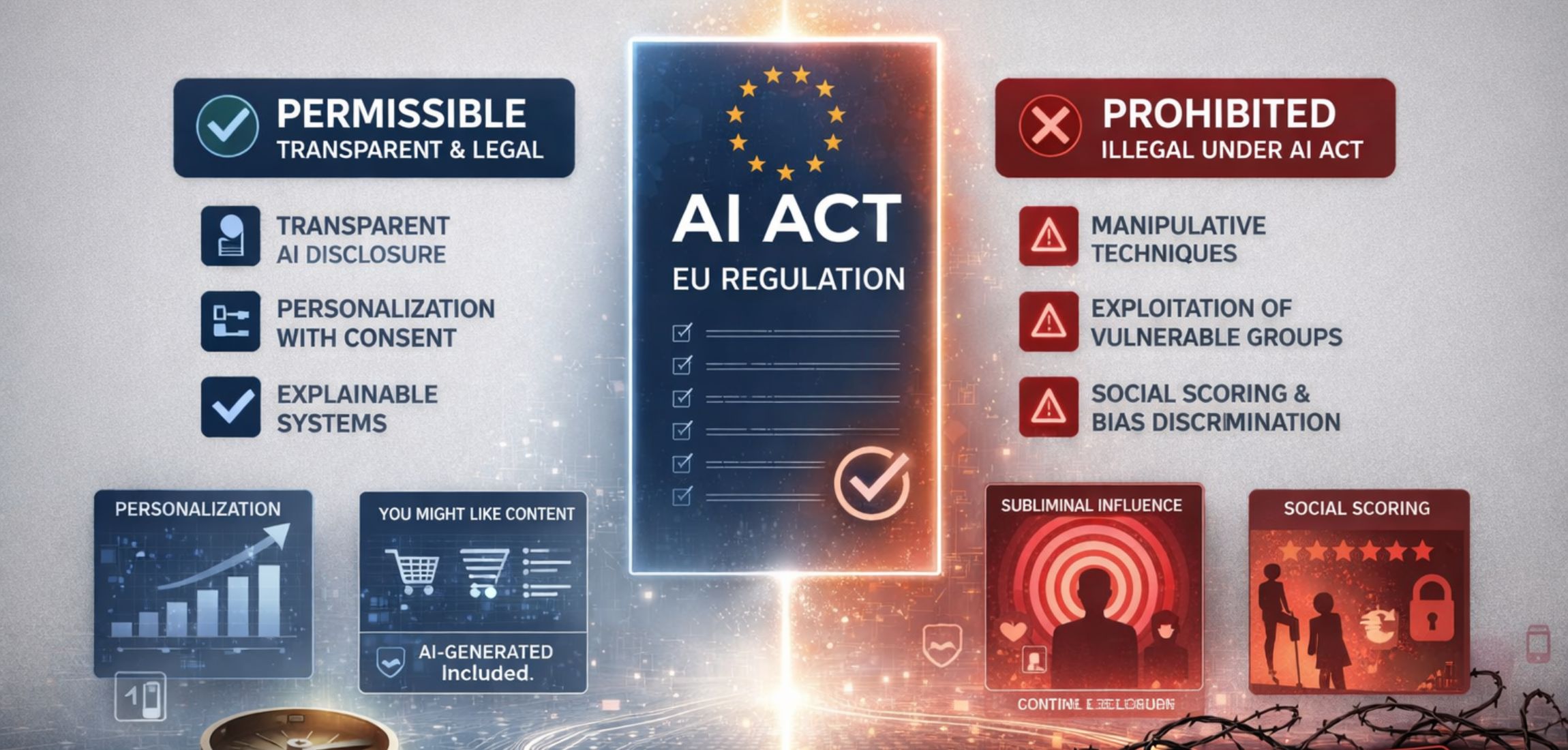
AI Act and Marketing: What Will Become Illegal and What Will Not
The AI Act and marketing strategy are becoming structurally intertwined as artificial intelligence moves from experimentation to regulated deployment within the European Union. With…


What makes a brand human when artificial intelligence becomes embedded in nearly every stage of communication is no longer the absence of automation, but the presence of recognisable judgment, accountability, and continuity. As generative systems make competent writing, visual production, personalization, and campaign adaptation widely accessible, many of the capabilities once associated with distinctive marketing are becoming standard infrastructure.
This does not mean that brands will become indistinguishable. It does mean that familiar signals of differentiation are weakening. Production quality can be replicated. Tone can be simulated. Content can be adapted to multiple audiences with little delay. Even apparent spontaneity can be generated according to predefined stylistic rules.
Under these conditions, the human quality of a brand cannot be established through surface characteristics alone. It must emerge from how the organisation interprets situations, makes choices, accepts consequences, and sustains a coherent relationship with its audiences over time.
For much of the digital era, the ability to produce consistent, polished communication represented a meaningful organisational advantage. It required specialised skills, sufficient resources, and coordination across marketing, design, and management.
Artificial intelligence changes this economic structure. Competent content is becoming less scarce. Brands can generate multiple campaign concepts, rewrite messages for different audiences, localise material, test variations, and maintain a high publishing frequency without proportionally expanding their teams.
The result is not necessarily better communication. It is more communication produced at a lower marginal cost.
As output expands, technical quality becomes a weaker signal of organisational quality. A well-written article no longer proves that a company has developed a meaningful perspective. A visually coherent campaign does not necessarily indicate a strong internal identity. Fluency can be produced without depth, and consistency can be achieved without conviction.
This distinction matters because audiences do not form durable relationships with production capacity. They form them with perceived intent, competence, and reliability.
It may be tempting to define a human brand as one whose communication is created entirely by people. That position is difficult to sustain and strategically unhelpful.
Brands have never communicated through unmediated individual expression. Their public identities have been constructed through teams, agencies, editors, researchers, designers, and institutional approval processes. AI adds another layer of mediation, but it does not create mediation itself.
The more relevant question concerns the relationship between technological assistance and organisational responsibility. A brand may use AI extensively while retaining clear judgment over what it communicates and why. Another may publish material written entirely by people while behaving impersonally, inconsistently, or without accountability.
Humanity is therefore not located in the production method alone. It is reflected in whether communication remains connected to actual organisational beliefs, decisions, and conduct.
This is closely related to the problem of personal branding in the age of AI-generated identity, where visibility can increasingly be maintained without continuous personal participation. In both cases, the central issue is whether representation remains meaningfully connected to the person or organisation being represented.
Artificial intelligence is effective at producing alternatives. It can generate language, images, predictions, and recommendations based on patterns in existing information. What it cannot independently determine is which choice an organisation should make when several options are technically plausible but strategically different.
That decision requires judgment.
Brand judgment involves evaluating context, recognising trade-offs, and deciding what should not be communicated even when it may perform well. It includes choosing whether a message is appropriate, whether a cultural reference is legitimate, and whether short-term attention is worth the reputational consequences it may create.
As marketing after automation transfers more procedural work to machines, human contribution moves toward these interpretive responsibilities. The value no longer lies primarily in producing each asset manually. It lies in setting direction, identifying limits, and understanding what an automated system cannot be permitted to optimise without qualification.
This is not a symbolic role. Poor judgment can be scaled as easily as good execution. Automation increases the importance of strategic decisions because it accelerates their consequences.
AI systems can reproduce a brand’s vocabulary, sentence structure, visual language, and preferred emotional register. They can make communication appear consistent across hundreds of outputs.
But coherence is more demanding than stylistic consistency.
A coherent brand aligns what it says with what it does. Its public positions correspond reasonably with its operational decisions. Its treatment of customers, employees, partners, and data does not fundamentally contradict its stated values. When conditions change, it can explain why its decisions have changed without rewriting its history.
This form of coherence develops over time. It depends on institutional memory and on the willingness to accept constraints created by previous commitments.
A generated tone can imitate continuity. It cannot create the underlying consistency of behaviour that makes continuity credible.
This distinction will become increasingly visible as audiences encounter more technically polished communication. When linguistic and visual competence become common, contradictions between message and conduct may become more consequential, not less.
One of the strongest indicators that a brand remains human is its capacity to accept responsibility.
Automated systems complicate accountability because they distribute decisions across models, platforms, data sources, vendors, and internal teams. When communication fails, organisations may describe the outcome as a technical error, an unintended model response, or a problem with insufficient oversight.
These explanations may be accurate. They do not remove responsibility.
A brand that benefits from automation remains accountable for the systems it deploys, the objectives it establishes, and the conditions under which outputs are published. Human governance does not disappear because execution has been delegated.
This matters especially when errors affect people rather than performance metrics. Misleading recommendations, discriminatory targeting, inappropriate messages, or manipulative interfaces cannot be treated solely as optimisation failures. They are organisational decisions expressed through technical systems.
Brands become less human when responsibility dissolves into infrastructure. They become more credible when they can explain what happened, acknowledge the consequences, and change the conditions that produced the problem.
Generative systems are trained to identify and reproduce patterns. Their outputs often converge toward forms that are clear, balanced, and broadly acceptable. This is useful for routine communication. It can also produce a subtle uniformity.
Human brands retain specificity.
Specificity may appear in the questions an organisation chooses to examine, the trade-offs it is prepared to discuss, or the areas in which it refuses to claim certainty. It is visible in language shaped by actual experience rather than generic positioning. It also appears in the decision to remain silent when there is nothing meaningful to add.
This does not require deliberate imperfection or theatrical informality. Attempts to manufacture human irregularity can become another style convention, easily replicated by AI.
The stronger signal is intellectual particularity: a recognisable way of interpreting the market that cannot be reduced to a tone prompt. This develops through accumulated experience, institutional knowledge, and sustained engagement with difficult problems.
Much digital communication is designed around response extraction. Messages are tested according to whether they generate clicks, registrations, purchases, or measurable engagement. AI improves the efficiency with which these responses can be pursued.
Relationships require something broader. They depend on recognition, memory, mutual expectations, and the possibility that interaction can influence both sides.
A brand that treats every encounter as an optimisation opportunity may become highly responsive without becoming relational. It can adapt continuously to the consumer while remaining unchanged by the consumer.
Human relationships involve a degree of reciprocity. Organisations listen, reconsider, and occasionally alter their conduct because of what they learn. This is different from using feedback exclusively to improve persuasion.
The distinction may be difficult to observe in individual interactions, but it becomes visible over time. Audiences notice whether engagement influences organisational behaviour or simply provides additional data for more precise targeting.
As AI use becomes widespread, some organisations may attempt to signal humanity through warmer language, informal visual styles, behind-the-scenes content, or frequent references to their people. These elements can support credibility, but they cannot establish it independently.
Humanity is not an aesthetic treatment.
A brand does not become human because it uses conversational language or displays employees in its communication. It becomes recognisably human when its decisions reflect judgment, when its commitments impose real constraints, and when responsibility remains attributable.
This may produce less communication rather than more. It may require slower responses, qualified claims, or visible uncertainty. Such choices can appear inefficient within systems designed for continuous output. Yet they may become increasingly valuable as synthetic communication expands.
When everyone uses AI, competitive advantage will not arise from using it or refusing it. Both positions are too simple.
The more durable distinction will concern whether the organisation remains identifiable beneath the technology. Can audiences recognise its priorities across changing formats? Can they understand the reasoning behind its decisions? Does its communication reflect a stable relationship between stated values and observable conduct?
These questions move branding away from the production of identity and toward the governance of meaning.
Artificial intelligence can support that process. It can reduce repetitive work, improve access to information, and expand the range of possibilities available to creative and strategic teams. But it cannot relieve an organisation of the need to decide who it is, what it stands behind, and which consequences it is willing to accept.
A human brand is not the one that avoids machines. It is the one that can still be held to its choices.
Article by Dario Sipos.
Dario Sipos, Ph.D., is a Digital Marketing Strategist, Branding Expert, Keynote Public Speaker, Business Columnist, Author of the highly acclaimed books Digital Personal Branding and Digital Retail Marketing.
Readers who wish to explore the underlying research, citations, and peer-reviewed publications can find them via his Google Scholar Profile.
His verified academic identifier is available through ORCID.
The AI Act and marketing strategy are becoming structurally intertwined as artificial intelligence moves from experimentation to regulated deployment within the European Union. With…

Marketing after automation requires redefining what remains human in strategic communication. As artificial intelligence systems assume greater responsibility for targeting, optimisation…

More data in personalization strategy does not automatically produce better personalization outcomes. In contemporary digital marketing, the accumulation of behavioural…